
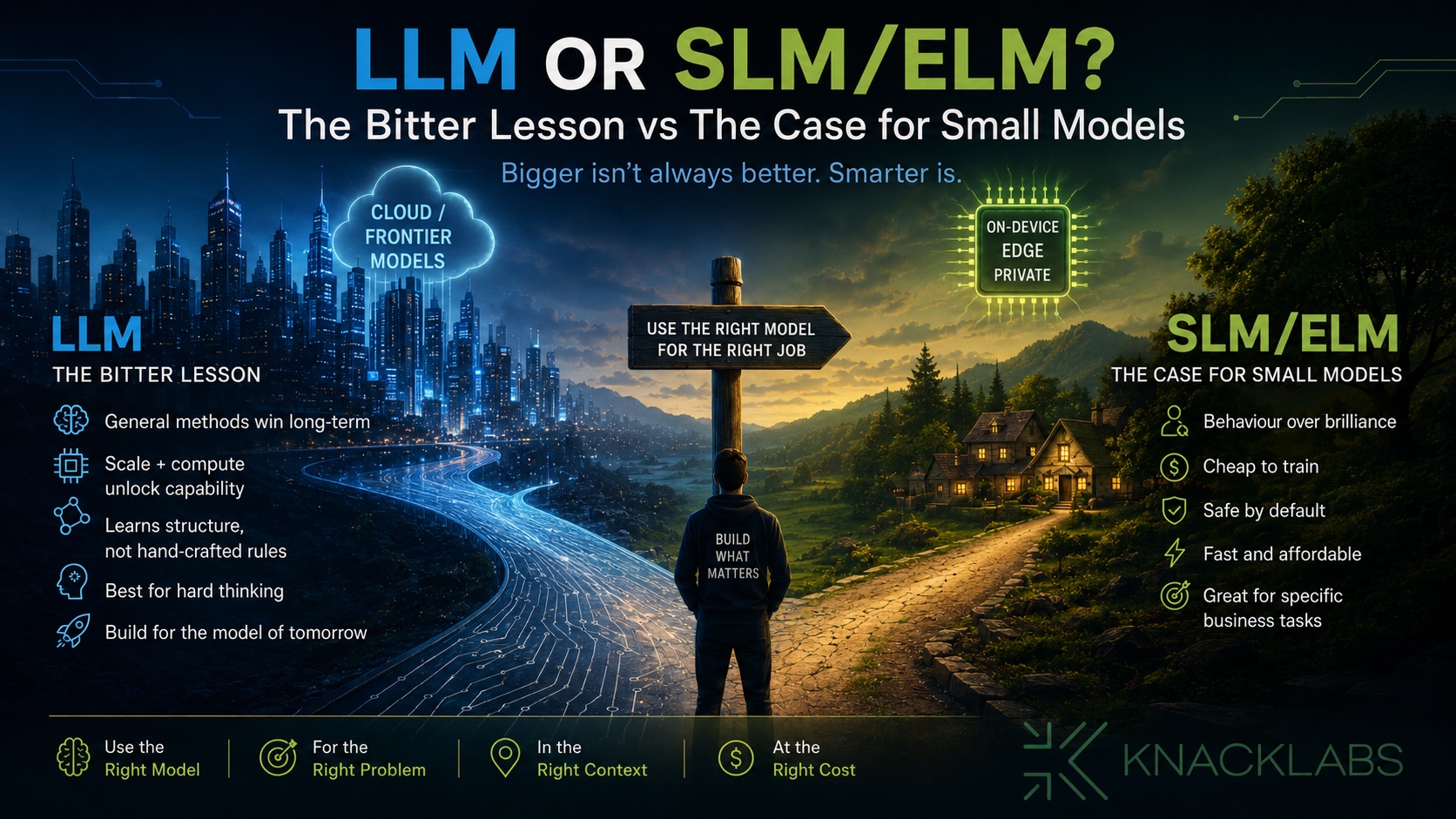
There is no single “best” LLM — only the best model for a workload, a budget, and a set of constraints. The frontier in 2025 is crowded and genuinely good; the useful question is not which model wins a leaderboard, but which one fits the job you actually have.
How to read a model comparison
- Capability — reasoning, coding, long-context, multimodality.
- Cost — price per token, and how that scales at production volume.
- Control — closed API vs. open weights you can self-host.
- Latency — how fast it responds under real load.
The contenders, at a glance
| Family | Strongest at | Best for |
|---|---|---|
| Claude (Anthropic) | Reasoning, long-context, safety | Analysis, agents, regulated work |
| GPT / o-series (OpenAI) | General capability, tooling | Broad product features, ecosystem |
| Gemini (Google) | Multimodal, very long context | Doc/video understanding at scale |
| Llama (Meta) | Open weights, customisable | Self-hosting, fine-tuning, control |
| Qwen (Alibaba) | Strong open models, multilingual | Cost-efficient self-hosted agents |
The real lesson
The teams getting the most out of LLMs in 2025 rarely bet on one. They route — a frontier model for hard reasoning, a cheaper or self-hosted one for high-volume routine calls — and they measure with their own evals instead of trusting a public benchmark.
“Don’t pick the best model. Pick the right model for each job, measure it on your own data, and be willing to use more than one.”
KnackLabs

.png)