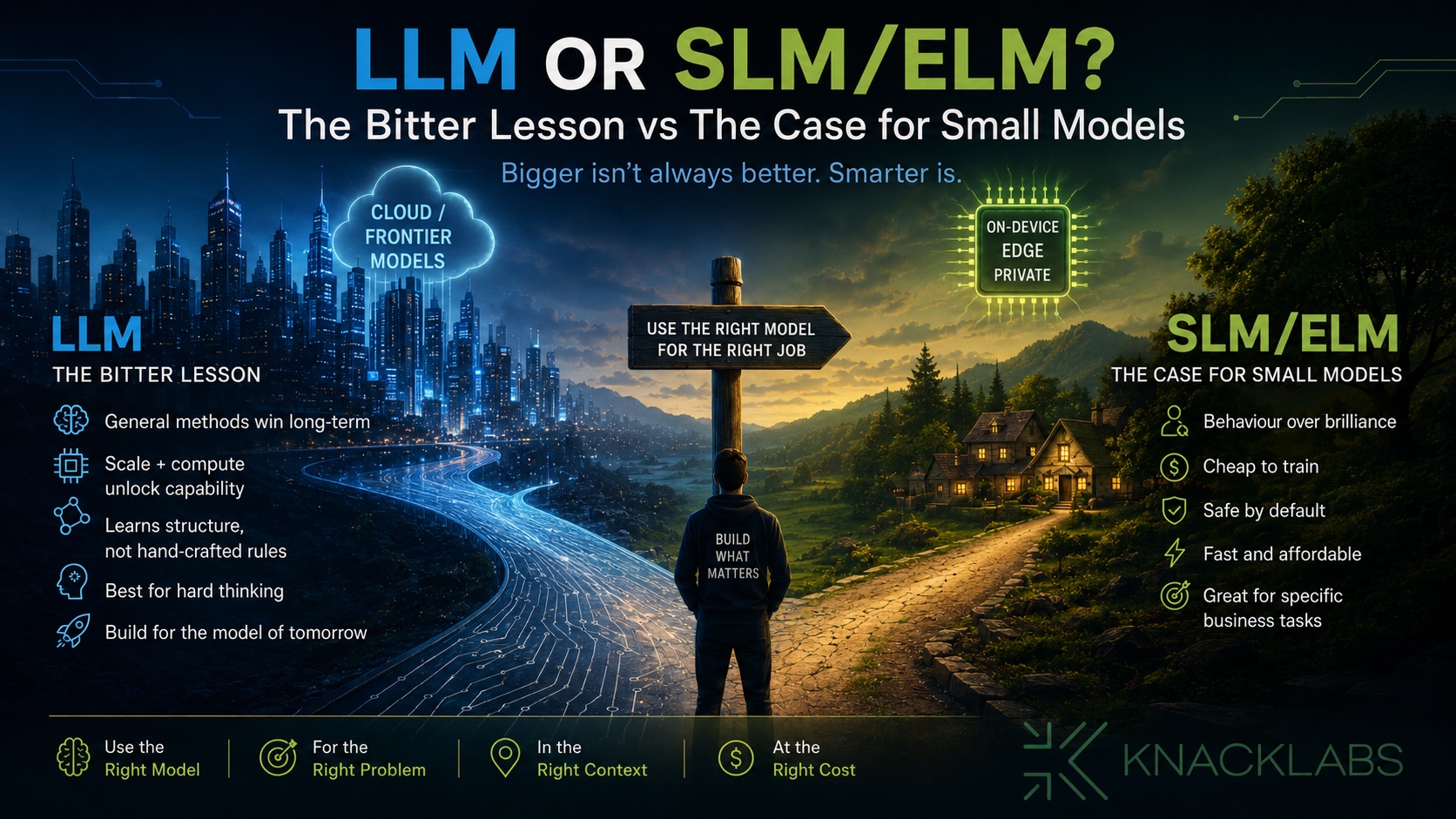
There is a genuine, unresolved debate running through every AI roadmap right now: is it better to bet on one giant, general model, or on many small, specialised ones? It sounds like a procurement question. It is really a question about where intelligence comes from — and two of the most thoughtful answers point in opposite directions.
Argument one: never bet against the model
The first answer starts with Rich Sutton’s The Bitter Lesson. Seventy years of AI research, Sutton argues, keep teaching the same uncomfortable thing: hand-crafted human rules are not the road to making machines smart. What actually wins is brute force — throwing compute at general methods of learning and search and letting the system find the structure itself. It is “bitter” because it means our clever, domain-specific ideas are usually a waste of effort in the long run.
Boris Cherny, the creator of Claude Code, lives by that rule. His version is blunt: never bet against the model. Models improve so fast that any special trick or scaffolding you build today is likely to be obsolete in six months — so build for the model you’ll have then, not the one you have now. He even suggests deleting your instruction files, like claude.md, once they grow long and start fighting the model. Better to keep a smart, general model and give it the right context to work with.
Argument two: stop making the model bigger
The other answer says reaching for a frontier model is often using a sledgehammer to crack a walnut. Kobie Crawford of Snorkel makes the case that small language models — SLMs, sometimes framed as expert or edge language models (ELMs) — can simply be better for real production work. In one study a 4-billion-parameter model beat a 235-billion-parameter giant on financial tool-use tasks.
The giant wasn’t out-reasoned. It lacked tool discipline — it queried tables that didn’t exist and then confidently made up an answer. The small model had been trained on the behaviours that matter: discover the available tables first, inspect the schema, check its own work, and fix its mistakes.
- Behaviour over brilliance — trained to use tools correctly and self-correct, not just to reason.
- Cheap to make — roughly double the pass@1 accuracy for under $500 a training run.
- Safe by default — small enough to run inside your own walls, so no sensitive data leaves the network.
- Fast and affordable — an order of magnitude cheaper to serve, with low latency at the edge.
So which view is right?
Lined up next to each other, the two aren’t really arguing about the same timeframe. One is about future potential; the other is about today’s performance.
- The Bitter Lesson is a long-term strategy. Scaling general intelligence is the most powerful force in the field. Over-invest in a bespoke small model today and a general model may quietly surpass it next year, for free.
- The Snorkel case is a practical solution for now. For specific jobs — finance, healthcare — reliability and behaviour matter more than general brilliance, and a small trained model delivers them today.
Our take: build for the future, solve for today
These aren’t mutually exclusive — they answer different questions. Follow the Bitter Lesson by keeping your instructions simple and leaning on general models for the hard thinking. But for the repetitive business tasks that have to be perfect, fast and cheap, train a small specialised model the Snorkel way. The honest answer to “LLM or SLM/ELM?” is usually both — routed to the job each one is genuinely best at.
“Both camps quietly agree on the thing that actually decides the outcome: high-quality data is the most important part of any AI system. Bet there, and you win either way.”
KnackLabs


.png)